Falling With Grace

I haven’t always been in a wheelchair. But even when I could walk, it was with an awkward, exaggerated gait. Because of my disability, my legs were weak and wobbly. In fact, I’ve had a lot of experience with falling. Some episodes were a bit humorous. I laughed the time I fell backwards into a laundry basket. I also laughed when I lost my balance and rode on an escalator sitting down. The lady who turned around to help me seemed quite perturbed by my laughter, but sometimes we just have to laugh at ourselves. And then there was the time the wind blew me over! Perhaps the most embarrassing episode occurred in a grocery store where I was shopping alone. I had just gotten my cart when for some unknown reason I found myself on the floor. Helpless, I looked at a gentleman nearby and literally said, “I’m crippled, and I can’t get up.” I wasn’t laughing then, but now it is kind of funny.

On my wedding day, during the lengthy time of taking pictures after the ceremony, my legs suddenly gave out and I plopped down with my wedding gown bunched around me. I sat there, looked up at my loving husband, and said, “Paul, I need you!” He knew from the start what he was getting into. (Well, maybe not everything…) Through our years together, if he saw me struggling, he would say, “If you’re going to fall, fall with grace!” Ha! As if I could control how I fell.

Not all my falls are funny. I’ve had my share of injuries and broken bones. But I appreciate the encouragement found in this Scripture verse:

The steps of a good man are ordered by the Lord, and He delights in his way, though he fall he will not be utterly cast down; for the Lord upholds him with His hand.
–Psalm 37:23,24

In the Amplified version the last phrase is translated: the Lord is the one who holds his hand and sustains him. This is God’s grace extended to us. So perhaps I can fall with grace!

But this verse is about more than a literal, physical collapse. It’s about our journey through life, specifically our walk of faith. Sometimes in our walk with the Lord, there is an unexpected bump, something that causes us to stumble, blows us over and knocks us down. And there are even times when an old habit or obsession beckons us, and we trip over temptation. Even in those times, God is there loving us, and His grace is there helping us. The fact is that sometimes we mess up, sometimes we fail, and sometimes we fall. The Apostle Paul reminds us that God’s grace is sufficient for us, and he also tells us that we “are never abandoned by God, we get knocked down but we are not destroyed.”–2 Corinthians 4:9(NLT)

The college I attended had a sloping sidewalk that went down from the dorms to the classrooms. This usually wasn’t a problem for me, except one winter day it was. The sidewalk was slick with ice. My feet flew out from under me and no matter how hard I tried I couldn’t get back on my feet. A strong, rather good looking young man came to my aid. He pulled me up on my feet, but my feet slid out from under me again, and again, and again. Finally, he picked me up and carried me to where I needed to go! This is just what grace does for us! Grace lifts us up and helps us get to where we are supposed to be.

When I fall, I am not falling alone. I am falling with grace. God’s grace is right there with me.

Through many dangers, toils, and snares,
I have already come;
’Tis grace hath brought me safe thus far,
And grace will lead me home.

–from the hymn Amazing Grace

If you would like to be notified of future posts, please subscribe below:

Down to My Level

The young man who married my granddaughter is quite tall. Standing several inches over six feet, he towers above me as I sit in my wheelchair. And Will likes to hug. Whenever he says his goodbyes to the family, he goes from person to person giving a big hug to each one before going out the door. When it’s my turn to be hugged, he does something different. He gets down on his knees! He comes down to my level. He does this so it is easier for me to reach him and hug him back. It’s very special to me.

Getting down on someone else’s level is a good thing. It helps us to connect with each other. We do this with children. As we physically get down on the floor to play with them, it enables us to interact with them and makes them feel important. Even if we don’t literally, physically go down to their level, we do it figuratively as we play their simple games, pretend with them, and use our imaginations. Children respond to the person who is willing to put themselves on their level. And so do I.

As we just finished celebrating the holiday season, I have been thinking about Christmas and what the birth of that baby in a manger really meant. How easily we read the Christmas story and quote the Scripture: “And the Word became flesh and dwelt among us.” But this was Jesus, the very Son of God, coming down to my level! He did it to reach me, and so I can respond to Him in return! How far did Jesus go to come down to my level? Way low! In order to reach me, He was made “lower than the angels”. He became one of us.

C. S. Lewis puts it well:

The Second Person in God, the Son, became human Himself: was born into the world as an actual man–a real man of particular height, with hair a particular colour, speaking a particular language, weighing so many stone [pounds]. The Eternal Being, who knows everything and who created the whole universe, became not only a man but (before that) a baby, and before that a foetus inside a Woman’s body. If you want to get the hang of it, think how you would like to become a slug or a crab.
–from Mere Christianity

The Creator of the universe, the One who created us, became part of His creation! It’s amazing! It’s unfathomable, unbelievable! It’s a mystery. Why did He do it? Why would He lower Himself to this level?

He made himself nothing by taking on the very nature of a servant, being made in human likeness, and being found in appearance as a man, he humbled himself by becoming obedient unto death–even death on a cross!
–Philippians 2:7-8(NIV)

Motivated by His love for us and in an effort to embrace us, to have a relationship with us, He didn’t just reach down, He came down! He came down to my level and I am so glad He did!

If you would like to be notified of future posts, please subscribe below:

Unwrapped Presents

It is said that good things come in small packages. I’m not sure about the validity of that statement, but I do know that the best gifts are the ones that I call “unwrapped presents”. I’m referring to presents that can’t be gift wrapped and put under a Christmas tree.

After my youngest son graduated from high school, he decided to join the Air Force. Elijah was stationed miles from home, so for Christmas he planned to celebrate with us by telephone. The family was gathered around the tree in the living room when he called, but as I was talking with him the doorbell rang. A little perturbed, I questioned who would be coming to see us on Christmas morning! I kept talking on the phone to Elijah as I went to answer the door and was shocked to find myself talking to him face to face! He had called us from our front porch and surprised us all by coming home! I don’t remember anything else I got for Christmas that year, but I do remember that my son came home. It was the best present I received!

One year my other son, Greg, wrapped up a litter box and gave it to me for Christmas. I wept when I realized what it was. The gift wasn’t the litter box. It was the kitten that would be coming later. But to me the gift went even beyond that. I realized that this was not just a gift from my son, but it included my husband’s approval as well, because he did not like cats. (Or so he claimed.) This gift from my son was also a gift of my husband’s love for me. His love could not be wrapped up as a present, but I was totally aware of the ‘unwrapped present’ that he was giving me that Christmas morning.

But the best unwrapped present I ever received was a gift from God. The Bible calls it an “indescribable gift.” God’s gift came naked into this world and died naked on the cross. It can’t be bought or boxed up with a pretty bow on top, because “the gift of God is eternal life through Jesus Christ our Lord.” (Romans 6:23) This is not the kind of gift that we grasp with our hands, but rather we receive it with our heart. God offers His gift to us with love. He gives it to us with grace and mercy when we accept it by faith. “For by grace you have been saved through faith…it is the gift of God.” (Ephesians 2:8) And here’s the exciting part! He offers this gift to everyone! It’s yours if you want it.

God’s gift doesn’t come in a pretty package. It can’t be seen or handled or opened, but God’s ‘unwrapped present’ is the best gift you will ever receive! Have you accepted the gift that God has for you?

For God so loved the world that He gave His only begotten Son that whoever believes in Him should not perish, but have everlasting life.
–John 3:16

If you would like to be notified of future posts, please subscribe below:

Blessings of Grace

My oldest grandson recently bought a house. He is a single, young man who works as a mechanic. He doesn’t have a lot of money, but by living simply, staying out of debt, and saving his money, he was able to buy a small, older home. It’s going to require some work and renovation, but Cody is capable. However, because he is not a wealthy man, he lacked what was needed to make the house a home. But not for long!! An abundance of household goods was given to him! I am not just talking about the usual dishes and pots and pans. He received nice used furniture, expensive tools and equipment, good quality materials and supplies, and groceries, too! These things were given to him, not just from friends and family, but from mere acquaintances and people he barely knew. One day as he was recounting to me some of the things he had been given, I said to him, “God sure is blessing you.” He responded, “Yes, and I don’t know why!” His response made me smile, but there’s a lot of truth in what he said.

It reminds me of an interaction my son once had with his father. When my husband passed away four years ago, my son shared the story in the eulogy he gave at the funeral, so I am quoting him. (Note: his father was also his pastor.) One service many years ago I came up to this altar and was balling my eyes out. Many times I have given my heart to the Lord and many times I have fallen away, and this particular time I was just beating myself up because I could not get around the fact that I didn’t deserve God’s grace. Pastor, my Dad, seeing I was struggling and with his hand on my shoulder, asked me what was wrong. And upon hearing me say, ‘I don’t deserve this’…he laughed! He chuckled and responded ‘None of us do!’ And that was just what I needed to hear. Not just those words, but his laugh, too.

Indeed, if we deserved it, it wouldn’t be grace! And the same is true of God’s blessings. The blessings we receive are from God’s goodness, not ours.

The goodness of God is that which disposes Him to be kind, cordial, benevolent, and full of goodwill toward men. He is tender hearted and of quick sympathy, and His unfailing attitude toward all moral beings is open, frank, and friendly. By His nature He is inclined to bestow blessedness and He takes holy pleasure in the happiness of His people.
–A. W. Tozer

Blessings cannot be earned. I realize there are principles and promises in the Bible that those who seek and serve God will be blessed, but this does not mean we are entitled or deserve to be blessed. It is always God’s love for us that sends blessings our way. This is why we come to Him with humility and gratitude. The blessings we receive from Him are because of His grace and mercy towards us. The answers to our prayers, the unexpected surprises and precious moments, the unexplainable peace and abundant joy are all blessings of grace!

“Praise God from whom all blessings flow!”

The Lord is gracious and compassionate, slow to anger and rich in love. The Lord is good to all; he has compassion on all he has made.
–Psalm 145:8-9 (NIV)

Oh, give thanks unto the Lord for He is good!
–Psalm 118:1

If you would like to be notified of future posts, please subscribe below:

Is an Invalid Invalid?

I like to read and I read a lot. Recently I have been reading The Librarian of Saint-Malo. Set in France in the early 1940’s, the main character is suffering from tuberculosis. Early in the book, she makes the statement, “Staying home tended to make me feel useless and invalid.” I stopped and read that sentence several times. Was she saying that staying in made her feel like an invalid or was she saying it made her feel invalid, as in unnecessary? Perhaps the author intended it to be a play on the word, giving it a double meaning. It was this sentence that led me to ask the somewhat nebulous, but thought-provoking question:

Is an invalid invalid?

The word ‘invalid’ has two different pronunciations and more than one meaning. As a noun it refers to one who is sickly or severely disabled. But as an adjective it refers to something that is ‘not valid’, meaning it is without legitimacy and is of no consequence. If something is invalid it has no purpose and is useless, no longer needed. So is an invalid invalid? Do they have purpose and do they have value?

I was twelve years old when I was admitted to the PA State Hospital for Crippled Children. (This hospital no longer exists and it was okay to use the term ‘crippled’ back then.) I was placed in a ward that held about thirty girls with varying degrees of disabilities. My bed was next to a girl who was not only physically disabled, but she was severely mentally challenged as well. She could not walk or talk, so she sat in her bed, rocking back and forth while making disturbing sounds of groaning and whining. She also had the habit of biting herself. I was warned that she might try to bite me. She was a big girl and I was afraid. Did this girl have any value?

One might think a girl like that would be forsaken and forgotten, but she wasn’t. Her family came to visit her and they loved her. They gave her value. She was also a child of God, created by Him and for a purpose. It might be hard for us to see any purpose in a life like that, but as disabled as she was, her existence was a valid one. I think maybe part of her purpose was to affect me. My fear turned to concern and compassion. My heart became more tender because of her.

Is the elderly mother with dementia who has forgotten the names of her children and thinks her son is her husband no longer a person of value? Is the man who fought many battles and was considered a hero, but is now too weak to crawl out of bed simply to be forgotten and neglected? Does that person who has grown into an adult, but mentally is still a little child have no worth? Has society labeled them:

God doesn’t see people like we do. He views things from another perspective. His value system is different than ours. Jesus told His disciples that the first would be last. He instructed them that if they wanted to be the greatest then they needed to be the least. In 1 Corinthians we are told that God uses the foolish to confound the wise. And God told Moses that He was the One who created the blind and the deaf and the dumb. We place our value and validation on our abilities, our appearance, our intelligence. God doesn’t. The people we disdain, mock or neglect may actually be some of God’s greatest treasures.

All have their worth and each contributes to the worth of the others.
–J.R.R. Tolkein

If you would like to be notified of future posts, please subscribe below:
Struggling with Suffering

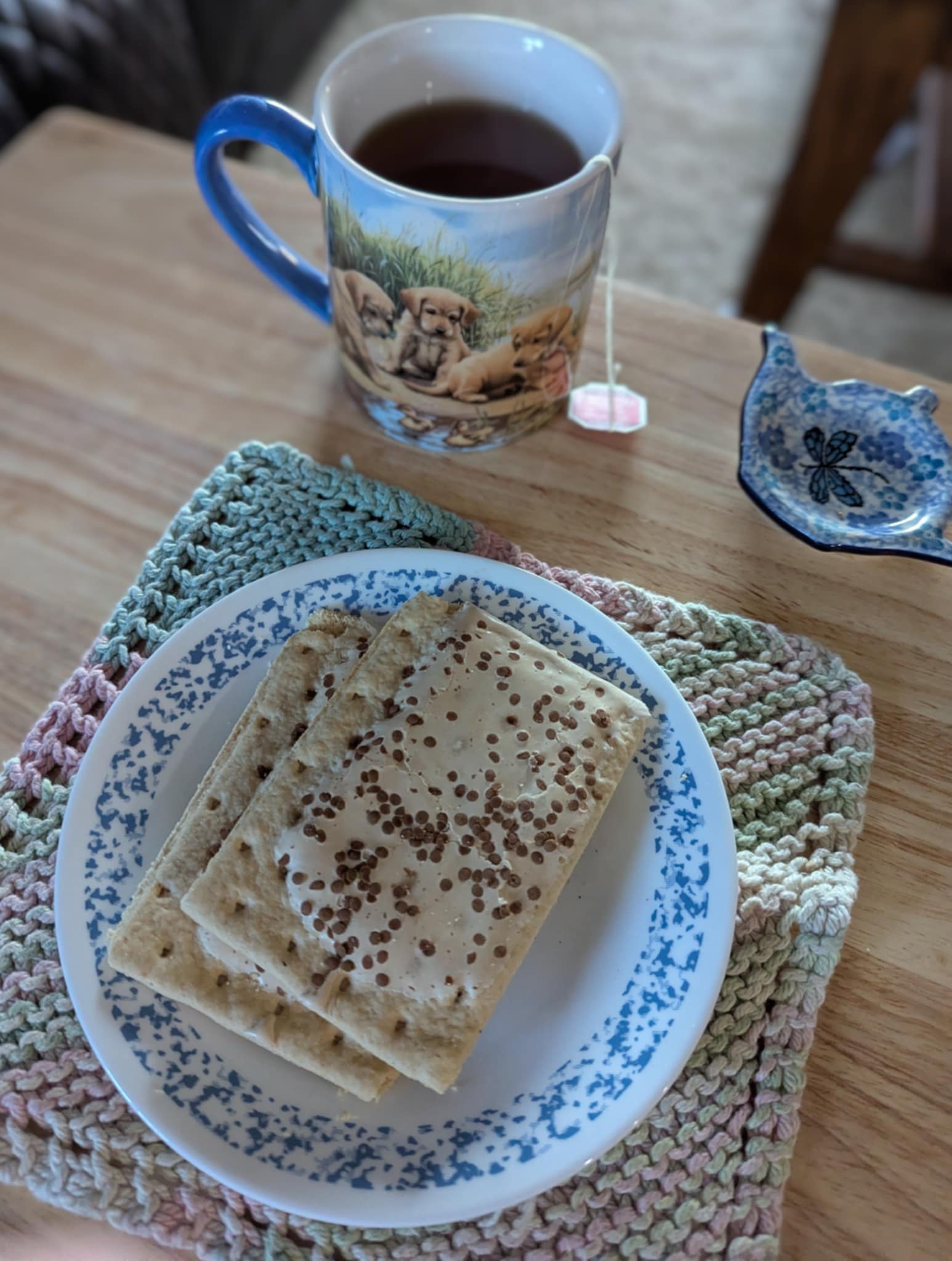
I wanted Pop-Tarts for breakfast, but I had a problem. The Pop-Tarts were kept on top of the refrigerator along with all the breakfast cereal and I couldn’t reach them. No one was home to help me, but the box was near the front so maybe, just maybe, I could figure out a way to get them. I stood up out of my wheelchair and leaned against the refrigerator for balance. Reaching up, I stretched my arms as far as I could, but I couldn’t even touch the box. So I figured it was time to get my grabber tool that helps me get things that are out of my reach. But it didn’t quite work. This time as I tried to maneuver my arm up toward the elusive box of Pop-Tarts, the added weight of my grabber made it difficult for me to raise it high enough. I plopped back down in my wheelchair. I was tired of the struggle. In fact, I was so upset I actually cried in frustration. Let me clarify. It wasn’t the lack of Pop-Tarts that was upsetting me, it was my lack of ability. Things I used to be able to do I no longer can. As my hands and arms have weakened and lost some mobility, my way of life has changed and it isn’t always easy. So on this particular morning I gave in to the struggle. But as I sat there venting my frustration by sobbing, I heard a little voice in my head say, “Is this helping?” And when I admitted to myself that it wasn’t, just like that the frustration and self-pity were gone! And I had to smile at my own foolishness. I realized some years ago that frustration doesn’t help the situation, it only makes me unhappy. But sometimes I forget!

Recently I came across this thought provoking question:

In this season of difficulty, are you wasting your suffering?
–from Seasons of the Woman’s Heart

What kind of question is that?! What does it mean? I understand the concept of wasting time and wasting money and wasting food, but what does it mean to waste suffering? To waste something means that we are not using something properly. It implies that the thing being wasted has value and a purpose. And there it is! Suffering has purpose. And this is part of the struggle we have with suffering. We don’t always understand the reason behind it, and we ask the question, “Why?” How is it even possible that something so hard, so painful, so devastating can have a beneficial purpose?

The Bible reveals several reasons for our suffering. It might be God seeking to get our attention and to draw us to Himself. Sometimes it is God working to improve our character or to build up our faith. The purpose may be to use us to touch someone else’s life or to bring God glory. But the real struggle with suffering isn’t about discovering the cause or the reason. The more urgent question is how will we respond to it. Will we be victorious in our suffering?

The whining, murmuring pang never does anybody any good.
–from Streams in the Desert

I am reminded of Joni Eareckson Tada, well-known quadriplegic, who has touched thousands not just with her testimony and talent, but also with her delightful demeanor and dedication to the Lord. Then there is Nick Vujicic, a preacher without arms or legs, who inspires many with his courage and humor. Evangelist Dorsey Ross, born with Apert Syndrome, encourages others to “overcome life’s obstacles”. These are just a few examples of what victorious suffering can accomplish!

The Bible instructs us to respond to our suffering with joy. We cringe at the thought! It doesn’t seem logical or possible. Not only does Scripture tell us to “rejoice always” and “in everything give thanks”, it also says this:

Dear brothers and sisters,when troubles of any kind come your way, consider it an opportunity for great joy.
–James 1:2 (NLT)

Perhaps one reason we are to respond with joy is because the Bible encourages us in Nehemiah 8:10 by declaring, “the joy of the Lord is your strength”!

Amid manifold trials, souls which love God will find reasons for bounding, leaping joy.
–from Streams in the Desert.

Does this mean we are always happy? No. Does it mean we never battle our emotions and struggle with frustration? No. (Remember my ordeal with the Pop-Tarts!) But it does mean we can reach up to God and tap into the joy we find in Him!

We are pressed on every side by troubles, but we are not crushed. We are perplexed, but not driven to despair. We are hunted down, but never abandoned by God. We get knocked down, but we are not destroyed.
–2 Corinthians 4:8,9 (NLT)

(In case you are wondering…I did have my Pop-Tarts the next morning when my daughter was there to get them down for me! Not a very healthy breakfast, I know, but I was quite happy.)

If you would like to be notified of future posts, please subscribe below:

Open Doors

When Willow comes to visit, we make sure all the doors are closed. My great granddaughter is an exuberant and active toddler. And she loves open doors. When a door is open, she’s ready to check it out! So the pantry door and cupboard doors, the bathroom door and bedroom doors are all kept closed. But if I go to my room when she is around, as soon as I open that door, she is right there with me, looking forward to going through it! To her an open door is an invitation and an opportunity. And indeed it is!

J. Wesley Clark was a minister. When he heard about a very small church in a very small town that needed a pastor, he and his wife decided to take a drive to see exactly where this church was located. As they drove past the church building, they noticed the front door of the church was wide open. God spoke to their hearts, That open door is for you. I was eleven years old when our new pastor shared his experience with us, and it has stayed with me. I loved the fact that God used a literal open door to show this man the open door waiting for him in his future.

The Lord opened a door of opportunity for me.
–2 Corinthians 2:12

There is a wide-open door for a great work here!
–1 Corinthians 16:9

There are several wonderful doors mentioned in the Bible. In the Old Testament book of Hosea, God sets before his people a “door of hope” and in the book of Acts there is offered to us a “door of faith”. But most exciting of all is when Jesus Himself declares: “I am the door. If anyone enters by Me, he will be saved.”-John 10:9 These doors are not locked and barred. They are an invitation from God Himself to all of us. An open door for us to enter.

The doors that lead us to God are of utmost importance. We don’t want to neglect them! But we have other open doors set before us as well. Doors of opportunity and direction. Will we go through them with confidence? Or does fear hold us back from something that God has planned for us? As we look for guidance in our daily living, we need to check out those open doors.

Sometimes open doors may be hard to recognize. We get so focused on one direction, our own ideas and set plans, that we miss the other opportunities available to us. When hard times come our way and circumstances are not to our liking, we keep looking at the door that is shut instead of finding another door that just might be open!

Often we look so long at the closed door that we do not see the one that has been opened for us.
–Helen Keller

I hope that Willow keeps her enthusiasm for open doors. That as she grows older she will continue to look for the adventure that is on the other side of that door. For that matter, I want that kind of attitude, too! I don’t want to miss out on an adventure or overlook an opportunity by failing to go through an open door that God has put in front of me. How about you?

If you would like to be notified of future posts, please subscribe below:

I Don’t Want To!

Moving isn’t easy. When my daughter and her family moved from New York to Minnesota, my granddaughter struggled. The day they left, they came to see me one more time and to say their goodbyes. My seven year old granddaughter clung to me and whispered imploringly in my ear, “I don’t want to!” I responded with “I know” and I assured her that it would be okay.

Sometimes I don’t want to either. I have had to move several times. The more difficult moves were leaving the churches and the people my husband and I had pastored to go to a new place of ministry. I remember on one occasion sobbing in the car and tearfully saying, “I can’t believe it’s over!” –the equivalent of saying, “I don’t want to.” But the most difficult move of all was when my husband unexpectedly passed away. I had to leave the home and life we had shared, and go on without him. My heart silently shouted, “I DON’T WANT TO!”

I’m not talking about the “I don’t want to” that is a defiant declaration of rebellion and stubbornness, but rather the cry that comes from fear and anxiety. Sometimes we are faced with changes in our lives that are out of our control and we just don’t know how we can go on. The loss of a spouse, the death of a child, a change in employment, or a dreaded diagnosis can lead us to despair and desperation. And we just don’t want it to be true!

But there is Someone we can go to, cling to, and cry to. We can lean into the arms of God and freely tell Him, “I don’t want to.” And He will respond with a gentle, “I know.” But with God there is more!! He not only understands and comforts, He goes with us!! If we lean on Him and trust in Him, He promises to be with us and to help us. No matter the circumstances or changes we are facing, God is right there, too!

Do not be afraid or discouraged.
For the Lord your God is with you wherever you go.
–Joshua 1:9 (NLT)
For God has said, ‘I will never fail you. I will never abandon you.’ So we can say with confidence, ‘The Lord is my helper, so I will have no fear.’
–Hebrews 13:5,6 (NLT)
Be assured, if you walk with Him and look to Him and expect help from Him, He will never fail you.
–George Mueller

If you would like to be notified of future posts, please subscribe below:

Christmas Movies & Superlatives

A new Christmas movie was released this year titled, “The Best Christmas Pageant Ever.” I haven’t seen the movie, but I have read the book and I’m familiar with the story. The movie centers around the Herdman siblings and their surprising involvement with a church Christmas pageant. A synopsis of the movie explains it this way: The Herdman kids are absolutely the worst. They lie. They steal. They bully…and they’ve hijacked the town Christmas pageant...[They] sneak into church looking for snacks and walk away with the lead roles in the town pageant. And so it appears the program will be ruined! But in spite of (or maybe because of) their unorthodox and unusual presentation the pageant is actually deemed the best Christmas pageant ever!

The phrase “best ever” is a superlative. It expresses the highest degree possible. Superlative adjectives are used to describe something of the highest (or lowest) quality. I remember my mother sharing this little rhyme with me, “Good, better, best. Never let it rest. Until your good is better, and your better best.” Best is the superlative. That’s as good as it gets!

Advertisers and public figures, such as politicians and athletes, are prone to use superlatives declaring they are the best, the greatest, the wisest, and the smartest. But when superlatives are overused they become hyperboles and meaningless. In the Christmas movie Elf, there’s a comical scene that illustrates this very well. When Buddy the Elf discovers that he was adopted as a baby and is not really an elf at all, he travels to New York City in search of his birth father. As he explores the city, he sees a small, nondescript diner with a sign in the window that reads: World’s Best Cup of Coffee. Buddy is ecstatic. He bursts into the restaurant yelling, “Congratulations! You did it!” In his simplistic view, he has no idea that it is merely an advertising gimmick. It is meaningless.

Was the Christmas pageant in the movie really the “best Christmas pageant ever”? Probably not. But I am reminded of an older movie considered a classic called, “The Greatest Story Ever Told.” Is this even possible? What story could possibly be the greatest? There is one! And it begins with the Christmas story! What God has done for us through the birth and life and death of His only begotten Son is indeed the greatest story ever told!

In Scripture, God is often acknowledged as the Most High God, declaring Him to be the Supreme Being over all. And yet it is difficult to use superlatives to describe who God is, because there is no one or anything to compare Him with. He alone is God! God Himself asks in Isaiah 40:25: To whom will you compare me? Who is my equal? and later He declares I am the Lord and there is no other; there is no God besides me. And when we think of what He has done for us and the blessings He gives us, we are often at a loss for words, because as David expresses in Psalm 139:6 Such knowledge is too wonderful for me, too great for me to understand. Nothing in this world compares with what God has done for us! We are given, according to the Bible, “indescribable joy”, “peace which surpasses all understanding”, and “exceeding grace”. Because of Him, we can “abound with hope” and “overflow with confidence”! And so we ponder the thought, Behold, what manner of love the Father has bestowed on us that we should be called children of God. (1John 3:1) It’s a love we can experience, but will never completely understand. There’s an abundance to God and His love for us that is greater than any superlative can express!

Thanks be to God for His indescribable gift!
–2 Corinthians 9:15

If you would like to be notified of future posts, please subscribe below:

Falling Leaves and Bare Branches

The popular Christmas song It’s the Most Wonderful Time of the Year has a line in it that declares, “It’s the hap-happiest season of all.” But apparently that’s not actually true. Statistically, America’s most favorite season of the year is autumn. There’s something about the sweater weather, pumpkin spice everything, and the colorful fall foliage that people really appreciate and enjoy. But I am not one of those people. I have a tendency to view autumn as an omen of what is to come–a long cold, snowy winter.

I must admit that this year the fall season was especially enjoyable. It was warm, sunny and bright. The leaves seemed more colorful than usual with varying shades of red and orange and golden yellow.

This tree was absolutely beautiful! But then something happened! The colorful leaves did not stay. One by one they fell to the ground until nothing remained on the tree. All that was left on the tree were bare branches. Not so pretty now, is it?

Photos by Eva Marie Husted

Why do the leaves have to fall off anyway? I did a little research. Obviously, they fall for a reason. Without getting into all the science behind it, simply stated, it’s for the sake of the tree and in preparation for that cold and snowy winter that lies ahead. Without the leaves, the tree is able to retain the water it needs during the winter months which reduces the amount of energy the tree needs to survive. And those bare branches are no longer weighted down with leaves and are able to withstand the snowfalls that come with the winter season. Even the fallen leaves serve a purpose as they give nutrients to the soil. Barren seasons do have purpose.

Every season has its purpose. Ecclesiastes 3:1 tells us, “To everything there is a season, a time for every purpose under heaven.” And verse 11 declares, “He [God] has made everything beautiful in its time.” But let me clarify. Certainly this is true of the seasons found in nature, but more importantly it is also true concerning the seasons of our individual lives. This chapter in Ecclesiastes gives us a glimpse of some of the seasons we encounter in living.

A time to be born, and a time to die; a time to plant, and a time to pluck up what was planted; a time to kill, and a time to heal; a time to break down and a time to build up; a time to weep, and a time to laugh; a time to mourn, and a time to dance; a time to cast away stones, and a time to gather stones; a time to embrace and a time to refrain from embracing; a time to gain, and a time to lose; a time to keep, and a time to throw away; a time to tear, and a time to sew; a time to keep silence, and a time to speak; a time to love, and a time to hate; a time of war, and a time of peace.
–Ecclesiastes 3:2-8

Some seasons of life are easier than others. It is difficult to see the purpose or benefit of a “barren season” in life. When we face loss and sorrow, we feel stripped bare and vulnerable. Like the bare branches of a tree, our foliage has fallen off and we feel exposed and ugly and useless. What good can there possibly be in this horrible time of life?! Could it be that God is preparing us for a season yet to come? Could it be He is actually strengthening us or even protecting us? Our difficult seasons are made easier to bear when we learn to trust that God is working in our lives for a purpose and for our benefit.

In her book, Anonymous, Alicia Britt Chole makes a similar comparison. Referring to the silver maple that grows in her yard she writes:

Bare, her lean limbs can support the coming snow and ice. But that weight would be too much for her frame in all its fullness. Lighter is better for the deep work of winter.
So she bows. She bends. She surrenders to thinning and in doing so thickens her foundation for an even more glorious summer to come.
In the same way, submission to God’s seasons will be our saving strength. To resist thinning is to risk collapse. The future is weighty, capable of
crushing the unprepared.

As we go through the barren seasons of our life, there is a calm assurance that comes when we trust God, knowing He is always faithful to provide strength and grace in our time of need, knowing He is always working on our behalf even in those times of great loss. Only God knows what the future holds and He lovingly prepares us for the next season of our life.

A poem to ponder:

A Measure of Grace

Deciduous trees are finally “baring it all” in defiance of the coming winter.
Soon they’ll be stark naked, without leaves on their branches to catch any frigid gusts.
True, they might freeze—I’ve seen it happen before—but this baring removes much of the potential risk of broken limbs, along with other things that might hinder
Their successful passage through the cold, through the long nights, through the blind icy thrusts
That seem to come from everywhere in the darkest time of the calendar here in the northern half of the world.
It’s those blind icy thrusts that I and all of us need to learn not to fear.
They’re the unexpected moments for which the deciduous trees, and we, need to prepare in order to find new buds, new chances, new vistas unfurled
That we may not even understand at first but will be revealed to us as this creaky old year
Stumbles fitfully away and a new one crawls in on hands and knees, not yet able to speak but with its message in its tiny little hands tightly curled.
It’s waiting to pass that message to us at the appropriate time, in the appropriate way, in the appropriate place…
Provided we’ve rested, healed, learned the lessons of the blind icy thrusts, embraced the dark, and achieved from doing all that—as most deciduous trees do—a measure of grace.

by Ben Neideigh

If you would like to be notified of future posts, please subscribe below: