May the God of hope fill you with all joy and peace as you trust in him, so that you may overflow with hope by the power of the Holy Spirit. – Romans 15:13
Moving isn’t easy. When my daughter and her family moved from New York to Minnesota, my granddaughter struggled. The day they left, they came to see me one more time and to say their goodbyes. My seven year old granddaughter clung to me and whispered imploringly in my ear, “I don’t want to!” I responded with “I know” and I assured her that it would be okay.
Sometimes I don’t want to either. I have had to move several times. The more difficult moves were leaving the churches and the people my husband and I had pastored to go to a new place of ministry. I remember on one occasion sobbing in the car and tearfully saying, “I can’t believe it’s over!” –the equivalent of saying, “I don’t want to.” But the most difficult move of all was when my husband unexpectedly passed away. I had to leave the home and life we had shared, and go on without him. My heart silently shouted, “I DON’T WANT TO!”
I’m not talking about the “I don’t want to” that is a defiant declaration of rebellion and stubbornness, but rather the cry that comes from fear and anxiety. Sometimes we are faced with changes in our lives that are out of our control and we just don’t know how we can go on. The loss of a spouse, the death of a child, a change in employment, or a dreaded diagnosis can lead us to despair and desperation. And we just don’t want it to be true!
But there is Someone we can go to, cling to, and cry to. We can lean into the arms of God and freely tell Him, “I don’t want to.” And He will respond with a gentle, “I know.” But with God there is more!! He not only understands and comforts, He goes with us!! If we lean on Him and trust in Him, He promises to be with us and to help us. No matter the circumstances or changes we are facing, God is right there, too!
Do not be afraid or discouraged. For the Lord your God is with you wherever you go. –Joshua 1:9 (NLT)
For God has said, ‘I will never fail you. I will never abandon you.’Sowe can say with confidence, ‘The Lord is my helper, so I will have no fear.’ –Hebrews 13:5,6 (NLT)
Be assured, if you walk with Him and look to Him and expect help from Him, He will never fail you. –George Mueller
If you would like to be notified of future posts, please subscribe below:
A new Christmas movie was released this year titled, “The Best Christmas Pageant Ever.” I haven’t seen the movie, but I have read the book and I’m familiar with the story. The movie centers around the Herdman siblings and their surprising involvement with a church Christmas pageant. A synopsis of the movie explains it this way: The Herdman kids are absolutely the worst. They lie. They steal. They bully…and they’ve hijacked the town Christmas pageant...[They] sneak into church looking for snacks and walk away with the lead roles in the town pageant. And so it appears the program will be ruined! But in spite of (or maybe because of) their unorthodox and unusual presentation the pageant is actually deemed the best Christmas pageant ever!
The phrase “best ever” is a superlative. It expresses the highest degree possible. Superlative adjectives are used to describe something of the highest (or lowest) quality. I remember my mother sharing this little rhyme with me, “Good, better, best. Never let it rest. Until your good is better, and your better best.” Best is the superlative. That’s as good as it gets!
Advertisers and public figures, such as politicians and athletes, are prone to use superlatives declaring they are the best, the greatest, the wisest, and the smartest. But when superlatives are overused they become hyperboles and meaningless. In the Christmas movie Elf, there’s a comical scene that illustrates this very well. When Buddy the Elf discovers that he was adopted as a baby and is not really an elf at all, he travels to New York City in search of his birth father. As he explores the city, he sees a small, nondescript diner with a sign in the window that reads: World’s Best Cup of Coffee. Buddy is ecstatic. He bursts into the restaurant yelling, “Congratulations! You did it!” In his simplistic view, he has no idea that it is merely an advertising gimmick. It is meaningless.
Was the Christmas pageant in the movie really the “best Christmas pageant ever”? Probably not. But I am reminded of an older movie considered a classic called, “The Greatest Story Ever Told.” Is this even possible? What story could possibly be the greatest? There is one! And it begins with the Christmas story! What God has done for us through the birth and life and death of His only begotten Son is indeed the greatest story ever told!
In Scripture, God is often acknowledged as the Most High God, declaring Him to be the Supreme Being over all. And yet it is difficult to use superlatives to describe who God is, because there is no one or anything to compare Him with. He alone is God! God Himself asks in Isaiah 40:25: To whom will you compare me? Who is my equal? and later He declares I am the Lord and there is no other; there is no God besides me. And when we think of what He has done for us and the blessings He gives us, we are often at a loss for words, because as David expresses in Psalm 139:6 Such knowledge is too wonderful for me, too great for me to understand. Nothing in this world compares with what God has done for us! We are given, according to the Bible, “indescribable joy”, “peace which surpasses all understanding”, and “exceeding grace”. Because of Him, we can “abound with hope” and “overflow with confidence”! And so we ponder the thought, Behold, what manner of love the Father has bestowed on us that we should be called children of God. (1John 3:1) It’s a love we can experience, but will never completely understand. There’s an abundance to God and His love for us that is greater than any superlative can express!
Thanks be to Godfor His indescribable gift! –2 Corinthians 9:15
If you would like to be notified of future posts, please subscribe below:
The popular Christmas song It’s the Most Wonderful Time of the Year has a line in it that declares, “It’s the hap-happiest season of all.” But apparently that’s not actually true. Statistically, America’s most favorite season of the year is autumn. There’s something about the sweater weather, pumpkin spice everything, and the colorful fall foliage that people really appreciate and enjoy. But I am not one of those people. I have a tendency to view autumn as an omen of what is to come–a long cold, snowy winter.
I must admit that this year the fall season was especially enjoyable. It was warm, sunny and bright. The leaves seemed more colorful than usual with varying shades of red and orange and golden yellow.
This tree was absolutely beautiful! But then something happened! The colorful leaves did not stay. One by one they fell to the ground until nothing remained on the tree. All that was left on the tree were bare branches. Not so pretty now, is it?
Photos by Eva Marie Husted
Why do the leaves have to fall off anyway? I did a little research. Obviously, they fall for a reason. Without getting into all the science behind it, simply stated, it’s for the sake of the tree and in preparation for that cold and snowy winter that lies ahead. Without the leaves, the tree is able to retain the water it needs during the winter months which reduces the amount of energy the tree needs to survive. And those bare branches are no longer weighted down with leaves and are able to withstand the snowfalls that come with the winter season. Even the fallen leaves serve a purpose as they give nutrients to the soil. Barren seasons do have purpose.
Every season has its purpose. Ecclesiastes 3:1 tells us, “To everything there is a season, a time for every purpose under heaven.” And verse 11 declares, “He [God] has made everything beautiful in its time.” But let me clarify. Certainly this is true of the seasons found in nature, but more importantly it is also true concerning the seasons of our individual lives. This chapter in Ecclesiastes gives us a glimpse of some of the seasons we encounter in living.
A time to be born, and a time to die; a time to plant, and a time to pluck up what was planted; a time to kill, and a time to heal; a time to break down and a time to build up; a time to weep, and a time to laugh; a time to mourn, and a time to dance; a time to cast away stones, and a time to gather stones; a time to embrace and a time to refrain from embracing; a time to gain, and a time to lose; a time to keep, and a time to throw away; a time to tear, and a time to sew; a time to keep silence, and a time to speak; a time to love, and a time to hate; a time of war, and a time of peace. –Ecclesiastes 3:2-8
Some seasons of life are easier than others. It is difficult to see the purpose or benefit of a “barren season” in life. When we face loss and sorrow, we feel stripped bare and vulnerable. Like the bare branches of a tree, our foliage has fallen off and we feel exposed and ugly and useless. What good can there possibly be in this horrible time of life?! Could it be that God is preparing us for a season yet to come? Could it be He is actually strengthening us or even protecting us? Our difficult seasons are made easier to bear when we learn to trust that God is working in our lives for a purpose and for our benefit.
In her book, Anonymous, Alicia Britt Chole makes a similar comparison. Referring to the silver maple that grows in her yard she writes:
Bare, her lean limbs can support the coming snow and ice. But that weight would be too much for her frame in all its fullness. Lighter is better for the deep work of winter. So she bows. She bends. She surrenders to thinning and in doing so thickens her foundation for an even more glorious summer to come. In the same way, submission to God’s seasons will be our saving strength. To resist thinning is to risk collapse. The future is weighty, capable of crushingthe unprepared.
As we go through the barren seasons of our life, there is a calm assurance that comes when we trust God, knowing He is always faithful to provide strength and grace in our time of need, knowing He is always working on our behalf even in those times of great loss. Only God knows what the future holds and He lovingly prepares us for the next season of our life.
A poem to ponder:
A Measure of Grace
Deciduous trees are finally “baring it all” in defiance of the coming winter. Soon they’ll be stark naked, without leaves on their branches to catch any frigid gusts. True, they might freeze—I’ve seen it happen before—but this baring removes much of the potential risk of broken limbs, along with other things that might hinder Their successful passage through the cold, through the long nights, through the blind icy thrusts That seem to come from everywhere in the darkest time of the calendar here in the northern half of the world. It’s those blind icy thrusts that I and all of us need to learn not to fear. They’re the unexpected moments for which the deciduous trees, and we, need to prepare in order to find new buds, new chances, new vistas unfurled That we may not even understand at first but will be revealed to us as this creaky old year Stumbles fitfully away and a new one crawls in on hands and knees, not yet able to speak but with its message in its tiny little hands tightly curled. It’s waiting to pass that message to us at the appropriate time, in the appropriate way, in the appropriate place… Provided we’ve rested, healed, learned the lessons of the blind icy thrusts, embraced the dark, and achieved from doing all that—as most deciduous trees do—a measure of grace.
by Ben Neideigh
If you would like to be notified of future posts, please subscribe below:
My two youngest grandbabies are close in age. Born a few months apart, they are both somewhere midway between the age of one and two. They are discovering more about themselves and learning to communicate. They are both learning the names of their body parts and it’s a fun game to play with them. Willow, who is actually my great granddaughter, is quite exuberant about it. She grins with glee and points triumphantly when asked “Where’s your nose?” or “Where’s your mouth?” But she’s really cute when asked about her ears. She takes both hands and tugs them out for you to see!
My grandson knows this game, too. Johnny doesn’t live near me, but I get to enjoy seeing his progress and talking to him through video chats. Recently, during one of our chats, I asked him “Where’s your nose?” He pointed to his nose and said, “nose”. So I asked, “Where’s your chin?” He appropriately touched his chin and replied, “chin”. Then I asked, ” Do you have ears?” And he startled me by saying, “No.” I chuckled, because it was cute and unexpected and funny. But it also caused me to think of another, somewhat similar and more serious question. That is, do you have ears to hear?
Little boys often had their own thoughts and while pursuing them did not always hear what you said. Many people of all ages were hard of hearing in all kinds of ways. –from the novel Kingdom Come by Daphne Simpkins
The above quote reminds us that it isn’t just the ‘hard of hearing’ who are hard of hearing. I mentioned this in my previous blog post, I Hear You! In that post I wrote, “But it isn’t just those who suffer from hearing loss that do not hear. There are other reasons that people fail to listen. It has to do with focus. When a person is focused on themselves it affects their ability to hear.” Distractions, such as television and cell phones, also affect focus and can keep people from hearing. But sometimes the reason people do not hear is simply because they don’t want to!
The expression “Talk to the hand!” accompanied with a raised hand in front of the face blatantly makes this clear. The unspoken and implied part of that statement is “cause this face ain’t listening.” It means you might as well talk to my hand, because I don’t want to hear what you’re saying! Sometimes people will cover their ears and make a lot of noise with their mouth as a way of refusing to hear. One Sunday morning I noticed a lady in the congregation sitting with her hands pressed over her ears. When I asked her about it after the service, she told me she didn’t want to hear what the preacher was saying. We may not literally cover our ears, but many times we do close our ears to what we do not want to hear.
Usually if someone refuses to listen, it is because they don’t want to hear another viewpoint or be given advice or receive any instruction. But quite often it also means they don’t want to hear the truth. This is especially true in spiritual matters.
Thomas Jefferson made his own Bible. He cut up his Bible, eliminated the portions he didn’t like or didn’t want to believe, and pasted the remaining verses into another book. This cut up version of the Word of God (It’s only the New Testament.) has actually been published and is available for purchase! This is a prime example of refusing to hear God’s truth.
It isn’t always easy to hear God’s voice. We can get it all mixed up. But sometimes the problem is our unwillingness to hear what He has to say. Sadly, many of us do not have ears to hear from God. From the very beginning, God longed for the people He created to hear Him. As much as we want God to hear us, He also wants us to hear Him!
From the Old Testament prophets to the last book of the Bible, God implores His people to hear Him. The book of Jeremiah is filled with pleas from God for them to hear Him, and over and over again the response is: “but they would not listen”. Jeremiah calls them “foolish people… who have ears and hear not”. One of the saddest verses in the Bible is Isaiah 28:12. “God has told His people, ‘Here is a place of rest; let the weary rest here. This is a place of quiet rest.’ But they would not listen.” (NLT) I wonder what blessings we miss, because we refuse to hear.
Do you have ears to hear? In the book of Revelation there are several verses that repeat the exhortation: “He that has ears, let him hear…” The New Living Translation words it this way: “Anyone with ears to hear must listen..” We all have ears. The question is: are we willing to hear God?
Who among you will give ear to this? Who will listen and hear… –Isaiah 42:23
If you would like to be notified of my future posts, please subscribe below:
I have a dear friend who is a blessing to me. She’s quick to offer me assistance when I need help and is willing to go the extra mile for me. (And I mean that literally.) We attend the same church, so I see her often. At a recent social function she was helping me get a hot cup of tea. In discussing what kind of tea I wanted, I mentioned that I had a hankering for some Constant Comment which is one of my favorite teas. A few days later she approached me after the Sunday morning church service with a gift bag in her hand and told me it was a belated birthday gift. There were several items in the bag, but the thing that gave me the most joy was the box of Constant Comment tea at the bottom of the bag! I was moved by the fact that she actually heard me! She heard, she listened, and she responded. Not everybody does.
I never expected to be hard of hearing. In my naivety, I had this inane idea that it wouldn’t happen to me. After all, I have enough issues to deal with! But it did happen to me and it is both frustrating and annoying! It’s frustrating to me and annoying to others. Sometimes as hard as I try I cannot hear what the other person is saying. I don’t mean to be rude or to ignore them, I just can’t hear!
But it isn’t just those who suffer from hearing loss that do not hear. There are other reasons that people fail to listen. It has to do with focus. When a person is focused on themselves it affects their ability to hear. They cannot hear because they’re too busy talking or intent on planning what they’re going to say next or thinking about something totally different than what the other person is saying.
Technology also affects our focus and ability to hear. The television blaring in the living room and the phone in our hand draws our attention away from those around us. It’s happened to me. I suddenly become aware that someone is speaking and I sheepishly ask “Oh, are you talking to me?”
Years ago there was a popular Verizon commercial that featured a man going around to far away and unusual locations with his cellphone and asking “Can you hear me now?” It became a popular catchphrase that is still used today. We say it with a chuckle and yet it’s a question that sometimes needs to be asked. Can you hear me now? It’s a joy to have a friend respond with “I hear you!”
But have you ever asked God that question? Have you ever wondered if He hears you? Let me assure you, He does! God’s answer to your question is YES! I hear you! Isaiah 59:1 tells us that God is not “too deaf to hear your call.” When nobody else will hear you or listen to you, He will! A line from an old, old chorus reminds us, “He’s not too busy to hear your heart’s cry.” Consider these verses:
The Lord hears his people when they call to him for help. –Psalm 34:17 (NLT)
I have called upon You, for You will hear me, O God; incline Your ear to me, and hear my speech. –Psalm 17:6
In my distress I called upon the Lord, And cried out to my God, He heard my voice from his temple, and my cry came before Him, even to his ears. –Psalm 18:6
…the Lord has heard the voice of my weeping, the Lord has heard my supplication, the Lord will receive my prayer. –Psalm 6:8,9
However, we are warned in Scripture that our sins can come between us and the ears of God. That verse in Isaiah that tells us God is not deaf goes on to say this in the next verse, “…your sins have hidden his face from you so that he will not hear.” How disheartening! But we have these encouraging words of David:
If I regard iniquity in my heart the Lord will not hear. BUT certainly God has heard me, He has attended to the voice of my prayer. Blessed be God who has not turned away my prayer nor His mercy from me. –Psalm 66:18-20
God is a ready listener. He leans toward us ready to hear us when we call on Him. If we humble ourselves before Him, He promises to hear our prayers. God hears us! He listens, He understands, and He responds!
If you would like to be notified of future posts, please subscribe below:
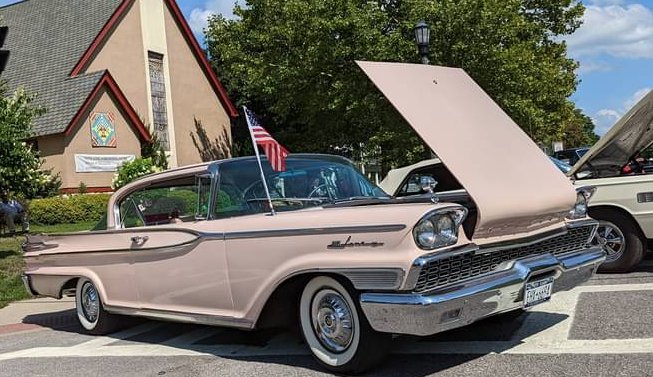
Each year in August the village of East Aurora, NY holds an annual classic car show. Main Street is closed off to traffic for the day and the street is lined with old cars and trucks, most of them beautifully restored. This is a large event and the street is filled with people walking and admiring the numerous entries.
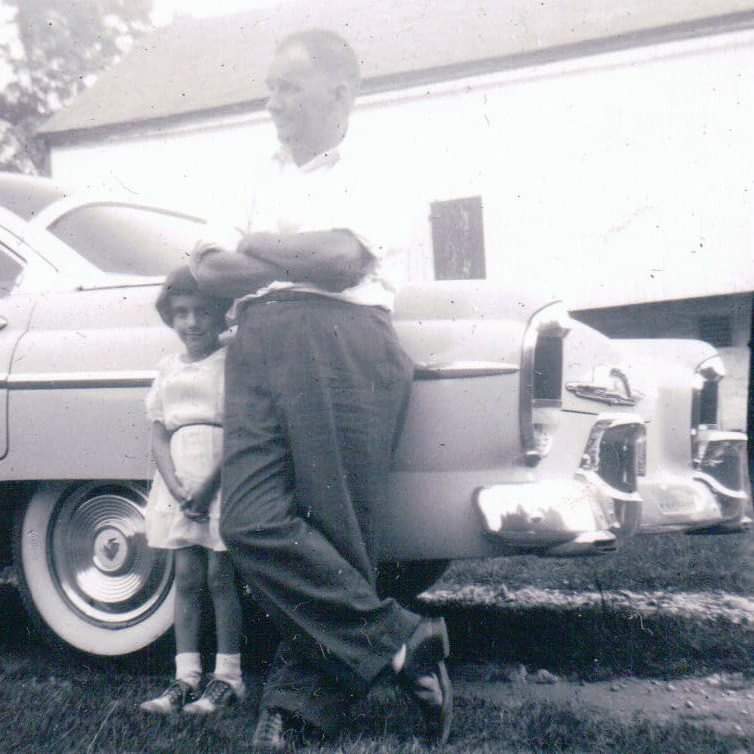
I enjoy going to the show, not only because of the classic cars that are there, but because of the memories they bring to my mind. The old Plymouth Belvedere reminds me of the one my husband owned when we were dating, and the large pink Mercury reminds me of my father. My father was a Mercury man. Whenever he bought a new car, it was always a Mercury. One year he couldn’t decide between purchasing a blue or a pink Mercury, so he discussed it with the family. A vote was taken and the general consensus was “Let’s get blue.” So he went and bought the pink one! The year I saw the gorgeous pink Mercury at the car show, I had to smile and take a picture.
The car show is more special to me now, because my older grandson has an entry in it! Cody owns a 1985 Dodge Ram50 truck that he has restored and made his own. It’s an unusual little truck that is admired by many.
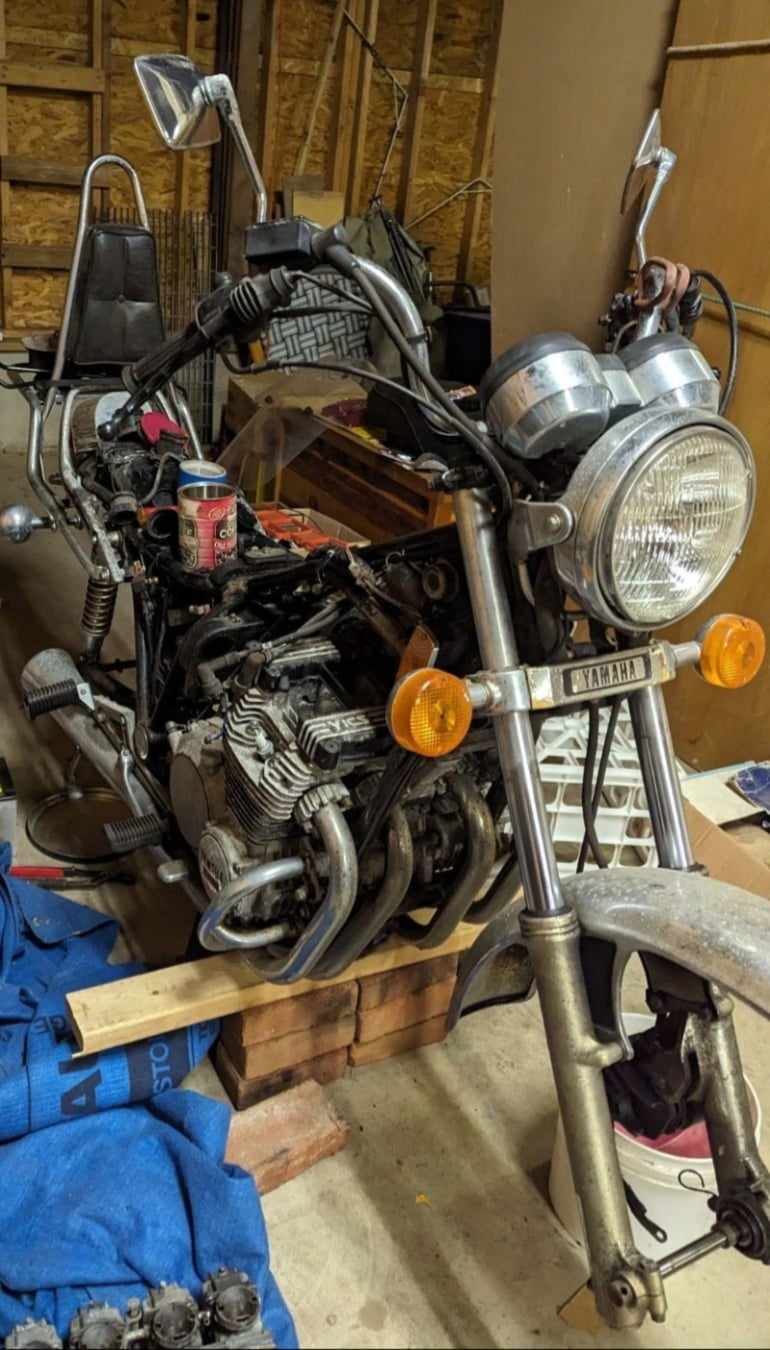
My grandson has a new restoration project. He’s been working on an old motorcycle. He likes sharing his progress with me, showing me the parts he’s gotten and taking me into the garage to see what he’s done. He has sent me a few pictures, too. Look at this!
But that’s not how it looked when he started! It took a lot of work to get it to look like that. At one point in time, Cody’s beautiful red motorcycle actually looked like this:
When Cody is restoring an old vehicle he spends a lot of time exploring junk yards and searching eBay for just the right part he needs. And then comes the struggle of putting it on and making it work. The restoration process takes a lot of time and patience.
I am reminded of a little chorus that was popular when my children were young:
He’s still working on me to make me what I need to be; It took Him just a week to make the moon and stars, the sun and the earth, and Jupiter and Mars, Oh, how loving and patient He must be, ‘Cause He’s still working on me!
Did you know that God is in the restoring business? And He does it with love and patience! One of the greatest things I am thankful for is that God is so patient with me.
Recently I saw a Facebook post that read simply and sadly, “I have failed!!!” I do not know the circumstances behind that statement and I was taken aback by the words. My response to the person who wrote it was, “Haven’t we all.” But this is when God can come into our lives to do the great work of restoration!
First and foremost, God desires to restore our relationship with Him. This is accomplished by a simple act of faith in what has already been done for us!
Since we have been made right in God’s sight by faith, we have peace with God, because of what Jesus Christ our Lord has done for us…our friendship with God was restored by the death of His Son… –Romans 5:1&10 (NLT)
But this is just the beginning. The restoration process continues because we are an imperfect people. We make mistakes and do wrong things. And sometimes our bad choices have dire consequences, not only messing up our lives, but affecting those around us. We become despondent, and in despair we hang our heads and cry, “I have failed!” Can restoration take place even then?
We tend to think that restoration is getting back what has been lost, but that’s not completely true. When a car is being restored, what is broken must be fixed, but what can’t be fixed needs to be replaced. Broken pieces and ruined parts are forever gone. A restored car is NOT the same car it originally was. With different parts and a new coat of paint, the car has been given a new life. It doesn’t get back the pieces that were ruined. And this is a truth for us as well. Some consequences of our actions can’t be changed. We can’t always go back to what we were or what we had, but we can be restored and given a new life!
Job lost everything. His health, his possessions, his family. But at the end of the story he is restored! His health returns and he has an abundant life. But the possessions and houses that were destroyed are forever gone and so is the family he lost to death. But God blessed him with new possessions and another family. He was restored and given a new life!
King David was a “man after God’s heart” and yet he really messed up! He committed a grievous sin by committing adultery with the neighbor’s wife and plotting to have her husband killed! There were consequences to his misdeeds. He suffered loss. But David knew about the God who restores! His prayer of repentance is found in Psalm 51. In the middle of his prayer, he prays for restoration.
Create in me a clean heart, O God, and renew a steadfast spirit within me. Do not cast me away from Your presence and do not take Your Holy Spirit from me. Restore to me the joy of Your salvation and uphold me by Your generous spirit. –Psalm 51:10-12
Being restored by God isn’t about what He does for us; it’s more about what He does in us. Remember the line from the 23rd Psalm, “He restoreth my soul.”
We can be assured that God can bring good out of the worst circumstances. We can trust Him to heal the heartache, to mend the broken pieces, and to restore our ruined lives. He can make “something beautiful” out of any mess!
If there ever were dreams that were lofty and noble, they were my dreams at the start, And hope for life’s best were the hopes that I harbor down deep in my heart. But mydreams turned to ashes and my castles all crumbled, my fortune turned to loss, so I wrapped it all in the rags of life and laid it at the cross.
Something beautiful, something good, all my confusion He understood. All I had to offer Him was brokenness and strife, but He made something beautiful of my life. –Bill Gaither
If you would like to be notified of future posts, please subscribe below:
I recently celebrated my birthday. Usually, with a few exceptions, my birthday celebrations are simple.They always have been. When I was a child my mother would bake a cake, slather it with frosting, put the right number of candles on it and that was about it. I don’t remember getting many presents. (Although there was the year my older, married sister surprised me with a particular, popular style dress that she knew I wanted. Sisters are good at that kind of thing.) But there are two things about my childhood birthdays that I do recall with fondness.
Our family had an unusual tradition of pulling ears on someone’s birthday. We would grab the birthday child’s ear lobe, and gently pull down counting up to their age with each tug of the ear and then with one final prolonged yank of the ear, we would add “and one to grow!” (I tried to implement this activity with my own children, but without success. We opted for playful birthday spankings instead.)
I also remember my father teasing me on my birthday about acting my age. But he did it with a humorous twist, always looking a year ahead of my actual age. For instance, on the day of my tenth birthday he looked at me and announced that now I was almost eleven!! He did this to me every year. This actually had a long lasting, positive effect on me as now I have a tendency to think I am a year older than I actually am, and when I stop to think about it, it’s nice to realize that I am not as old as I thought I was!
Children look forward to their birthdays, not just because of the party and the presents, but they are also excited about being another year older. They want to grow up! Children can’t wait to turn ten, and then they look forward to becoming teenagers. Teenagers long to be young adults and to reach that magical age of twenty-one. They are in anticipation of what privileges await them and what the future has for them. But somewhere between twenty-one and eighty-one, we begin to realize that with each birthday we are no longer “growing up”; we are just getting older. And getting older isn’t always easy.
Ecclesiastes gives a good, but bleak, description of what that means:
So remember your Creator while you are still young before those dismal days and years come when you will say “I do not enjoy life.” Thatis when the light of the sun, the moon, and the stars will grow dim for you, and the rain clouds will never pass away. Then the arms, that protected you, will tremble and your legs, now strong, will grow weak. Your teeth will be too few to chew your food and your eyes too dim to see clearly. Your ears will be deaf to the noise of the street. You will barely be able to hear the mill as it grinds or the music as it plays, but even the song of the bird will wake you from sleep. You will be afraid of high places and walking will be dangerous. Your hair will turn white; you will hardly be able to drag yourself along, and all desire will be gone. –Ecclesiastes 12:1-5 (Good News Translation)
So what are we to do about this inevitable process of aging? The whole idea of getting old can be disheartening and discouraging and depressing. How should we respond and act as we are getting older? Cosmetic companies and health gurus urge us to “defy aging”. That may sound good and inviting, but in reality it’s an impossibility. Our bodies do not and will not last forever. There is no elusive, magical fountain of youth. I like the concept of growing old gracefully, but what exactly does that mean? It involves acceptance and attitude. It means doing all we can for as long as we can. It is also the ability to laugh at ourselves and to be joyful and content in difficult circumstances. I recently saw this adage: “Forget about aging gracefully. Focus instead on aging gratefully.” I think the two go together. We need to guard ourselves against becoming grumpy old men and grouchy grannies.
Aging is out of your control. How you handle it though is in your hands. –Diane Von Furstenberg
Getting old is not without hope and purpose. The Psalmist recognized this when he declared, “I trust in You, O Lord. I say, ‘You are my God.’ My times are in Your hand.” (Psalm 31:14,15) In another Psalm, David attests to the faithfulness of God. “I have been young, and now am old; Yet I have not seen the righteous forsaken.” (Psalm 37:25) It is this knowledge and experience that causes him to have hope in God and to call on Him even in his old age. “And now, in my old age, don’t set me aside. Don’t abandon me when my strength is failing…Now that I am old and gray, do not abandon me, O God. Let me proclaim your power to this new generation.” (Psalm 71:9,18-NLT) And through the prophet Isaiah, God gives us this promise: “Even to your old age and gray hairs, I am He, I am He who will sustain you. I have made you and I will carry you…” (Isaiah 46:4-NIV)
Hope and heart needn’t fade as we age. –Arthur Jackson in Our Daily Bread
I still enjoy celebrating my birthday. I receive phone calls and gifts from my children, and homemade cards from my grandkids. I also get to make the menu for my birthday dinner. Whatever I want! I especially enjoy being surrounded by family and laughter around that dinner table. But I am most grateful that God has blessed me with another year of life, another opportunity to live for Him, to trust Him, and to glorify Him.
So be strong and courageous, all you who put your hope in the Lord! –Psalm 31:24 (NLT)
If you would like to be notified of future posts, please subscribe below:
Okay. I admit it. I was a Daddy’s girl. Oh, I loved both my mother and father, but my Daddy was special to me. In my childish eyes, he was perfect. And I was his “little princess”. My father was funny and fun. He sang silly songs like “There was a hole in the ground, the funniest hole you ever did see…” and he made us laugh with the stories he told about his childhood. He was the middle child in a family of 13 children (mostly boys) so he had plenty of stories to share!
My father attended a one room school. (This was another source of many of his stories–oh, the pranks the boys did in that school!) He didn’t go beyond eighth grade. Because of this, my father had great aspirations for me. His dream for me was that I go to law school and become, as he put it, a “woman judge”. This was an amazing thing considering his background and his ultra conservative upbringing, and that this was prior to the feminist movement. I didn’t fulfill that specific goal he had for me, but I did go to college and he cried the day he drove me there. I was the first one in the family to attend college and he was proud and pleased.
One day after I was grown and married and out of the house, my mother approached me with a concern. She shared with me that she often thought my father favored my older sister and she worried that I had been hurt by it. I was stunned!! I always thought I was the favorite!
It is not unusual for children to admire their fathers. Recently I was watching my great granddaughter crawling towards someone when her father happened to walk by. She promptly did an about face and crawled after him instead! I had to smile. What adoration she has for her daddy!
…the glory of children is their father. –Proverbs 17:6
There is so much more that I could say about my father. He was a good man who loved God, served in the church, and provided for his family. He worked hard as a salesman, but also maintained a small farm with a very large garden and a beautiful orchard. He took pride in his apples and grew the largest peaches I ever did see! I was happy to call him my Daddy.
As I got older, however, I began to realize that maybe my Daddy wasn’t so perfect after all. My father was a jokester, but sometimes he could joke too hard. My father loved playing games and it was serious business with him. He could be too competitive and at times the games would end with tension and arguments. I began to see that he could be too focused on himself and too demanding of others. He had a stubborn streak that could get him into trouble. I don’t share this to belittle him, but rather to point out that there is no perfect Daddy. Or is there?
We recently celebrated Father’s Day. In our Sunday morning worship service, one of the men expressed to the congregation that as hard as he tries to be a good father, he knows that he fails. But he went on to say that he was thankful for the “perfect heavenly Father who can stand in the gap” when he fails.
In the book, Ragman and other cries of faith, the author Walter Wangerin Jr shares this thought written in a letter to his son:
I had hurt you. I sat you down in a chair and left the room. I went out and I myself burst into tears. It was a terrible, thwarted thing–for me to cry. I said, “God, how can I know if I’m a good father to this child?” I said, “God, please you be father for him–“ And quietly I understood: in fact, God is your father, and a better one than I. –from “To Matthew, at His Confirmation
It was Jesus who encouraged His followers to view God as a father. When the disciples asked Jesus to teach them to pray, He instructed them to address God as Our Father, making His Father their Father. He was introducing them to a closer, more intimate relationship with a holy God. But how close can we get to “Our Father, which art in heaven”? Do we dare call him Daddy?
Daddy is such a sweet, childish name for a father. When we get older, we shorten it to Dad. But I called my father Daddy, even as a teen. And sometimes as an adult I would slip and revert to that tender loving term of affection for my father. Daddy. Can our heavenly father be a daddy to us? In Galatians 4:6 we are told that because we are children of God, we can cry out, “Abba, Father!” That word ‘Abba’ is an Aramaic affectionate term for father, the equivalent of papa or daddy. It speaks of a close, intimate relationship between father and child. That is the kind of relationship we can have with God!
My earthly father was my Daddy, but it is God, my heavenly Father, who is my perfect Daddy!
My Daddy and Me
If you would like to be notified of my future posts, please subscribe below:
Babies are born with an innate affinity for music. This is why singing lullabies calms a crying infant. I love watching my grandchildren respond to music. Little Willow grins with delight as she wiggles with the Wiggles on the TV screen, but when she is distraught and tired she has her favorite songs that calm her and help her go to sleep. I have another granddaughter who had a more “mature” taste in lullaby music. She found comfort in the voice of Johnny Cash. She was barely four when she became enthralled with Bruce Springsteen. (That took some parental supervision!)
My daughter sings with a local community chorale. I recently attended one of their concerts and enjoyed listening to their voices singing in harmony. I sat with a smile on my face. However, one of the songs they sang featured only the bass and tenor sections of the choir. And as they sang, my eyes filled with tears and my heart plummeted in sorrow. I was hit again with grief! The sound of those male voices reminded me of my husband’s love of singing and the loss of never hearing him sing again. This is the magic of music. It touches our emotions.
Music acts like the magic key to which the most tightly closed hearts will open. –Maria Von Trapp
Music can provoke passions, inspire unity, and move people to action. An example of this can be found in the 1912 workers’ strike against the abusive textile mill owners in Lawrence, MA. Included among those refusing to work were a large number of immigrant women. Many credited the success of the strike to the solidarity of these women. But Katherine Paterson, author of “Bread and Roses, Too” makes this comment: Otherssaidit was the songs that brought the strikers to victory. Little red books containing union songs were passed out. Although most of the women couldn’t read English, somehow they learned to sing in a way that made the police and militia tremble. ‘Beware that movement,’ one observing journalist said, ‘that generates its own songs.‘
Then there is the story of the young musician who took his talent and an old upright piano into the underground world of the New York City subway. As he began to play and sing the well-known Beatles song “Hey Jude”, something magical happened! John Colapinto describes it this way: In the course of two minutes, the potentially dangerous netherworld of the New York City subway… where eye contact is assiduously avoided, was transformed into a place of joy, camaraderie, connection…everyone on both platforms –male and female, Black and white, young and old– was singing, clapping, smiling at one another. The transformation was miraculous. This is what music can do!
There is all of this potential for music to improve lives. –Neuroscientist Jolene Johnson
Music has the ability to comfort and soothe, to encourage and inspire, to give joy and bring peace and hope. It has been found to be an instrument of healing for the hurting and the aged and even those suffering from dementia. Because music touches the soul, it lingers and provides solace when nothing else will. Carol Rosenstein whose husband struggles with dementia put it this way in an article written by Hannah Chenoweth: Music helps people find hope and joy, even in their darkest hour of suffering!
When my husband passed away a few years ago, my sorrow was deep. I hurt. But as I struggled to sleep at night, God ministered to me. Not through Scripture or prayer, but through song. As I lay alone and awake at night, a song would come to my mind, and the words and the melody would speak to my heart. Often I would listen to these songs in the night and they would bring me the comfort and the peace that I needed. I will never forget those precious times of God reaching out to me through music.
In the night His song shall be with me –Psalm 42:8
Music is God’s gift to us. It is a blessing that reaches deep inside of us and can connect us to God Himself. This is why music is an integral part of our worship. It speaks to our needs, prepares our hearts to receive, and leads us to praising Him.
Speak to one another in psalms and hymns and spiritual songs, [offering praise by] singing and making melody with your heart to the Lord. –Ephesians 5:19 (AMP)
Music does not just touch our emotions; it affects and influences are very inner well-being. Whether you’re singing the blues or worshipping God with songs of praise, whether you’re playing classical piano or listening to classic rock, whether you’re crooning a country ballad or just enjoying some jazz, your life is made better by that music. It’s not a cure-all or an emotional panacea, but it is a blessing. Music can express abundant joy and celebrate life! It can also soothe a troubled soul. Music can lift us out of depression and transport us to other places. What an amazing gift God has given us!
If you would like to be notified of my future posts, please subscribe below:
When I was engaged to be married, I remember telling my future husband that his mother was “small but powerful.” Just a couple inches over five feet, she was small in stature, but I saw something bigger in her. She had a strength beyond her size. She was a strong force in the family. She had to be! She was the mother of four big, boisterous boys and a feisty, determined daughter! I was a bit intimidated.
I was the first one to marry one of her sons, and his mother wasn’t too sure she liked the idea. She had a right to be concerned. Paul was only 18 when we got married!! Relatives and friends were telling her she should not let it happen. So she did what a good mother should do. She prayed! This is the true source of her strength. After much prayer, God assured her that this was indeed His plan and that He would provide and take care of us – her son and first daughter-in-law. And Mom C has been on my side ever since!
My mother-in-law is strong because of her intimate relationship with God. This close walk with God began when she was a child. I love her story of praying as a child that God would teach her to play the piano. She got up the next morning, sat down at the piano and played!! She’s been playing for Him ever since.
She is also strong because of her resourcefulness as well as her reliance on God. She has always done what needs to be done. As pastors of small churches, their financial situation was not easy. She knew how to stretch those dollars, and how to pray for what was needed. When she became a widow at the age of 54, her dependence on God continued. It is only now as I have faced the grief of losing my own husband the same way she lost hers that I understand and appreciate even more the strength of this little woman.
I must confess that there have been times of tension between us, perhaps an underlying sort of competition on my part, needing to prove myself as a young wife, a new mother and a pastor’s wife. This was especially true when she lived with us for a season. I could get snippy. She had a better way of dealing with it. She talked to me about any problem we had. I’m not talking about the fierce competition between us when we played Scrabble or Boggle or Phase10. That was pure fun! We had many good times, laughing and crying and praying together, often accompanied with a cup of tea.
My mother-in-law is now 91 and struggles with memory loss. She tends to repeat herself and has key phrases that she says to different people. But I have noticed that the repetitive statements she makes are all positive in nature. She can’t keep track of all her grandchildren and great grandchildren, forgetting who belongs to who. But she knows me! Almost every time she sees me, she hugs me and says with a smile, “You’re more like a daughter to me.” And I am honored.
She is smaller now than ever. Physically frail and shrinking in size, she doesn’t seem to be the strong woman of influence she once was. But to me she is still that little giant I admire.
Size isn’t what makes you a giant. It’s who you are, what you do, and who you rely on that determines your strength and success. I recently read the exciting Biblical account of David and Goliath, and I wondered, “Who is the true giant in that story?” Is it Goliath who in spite of his bigness ends up dead on the ground with his head cut off? Or is it the young lad brave enough to stand against the enemy because he knew God and relied on Him for the victory?!
I recently heard someone say, “Don’t underestimate the small ones.” And think about this:
Many small people, in small places, doing small things can change the world. –Eduardo Galeano
This is especially true when that small person or small place or small position is used by God. I am reminded of Susanna Wesley, a simple mother who taught her many children to love God and who is now known as the “mother of Methodism” because she was the mother of John and Charles Wesley. She had this to say about smallness: I am content to fill a little space if God be glorified. It is this kind of attitude that Jesus was referring to when He said, Whoever is the least among you is the greatest.(Luke 9:48)
I am grateful for my mother-in-law, for her example and her godly strength. A preacher and teacher as well as wife and mother, her knowledge of the Scriptures was astounding! And if you asked her to pray for you, be assured she did, and still does! I am proud to call her Mom. She is indeed “small, but powerful”, a little giant for God!
Her sons tower over her, but still look up to her!
(My husband is not pictured as this was taken a few months after his death. Also, since this picture was taken one of her other sons, Lawrence, has passed away. Her grief is great, but her faith is greater.)
If you would like to be notified of my future posts, please subscribe below:










 Mug of Hope